
Organized by IEEE Sensors Council Student branch chapter (SBC), School of Electronics Engineering, KIIT (DU), Bhubaneswar, India
Event Details:
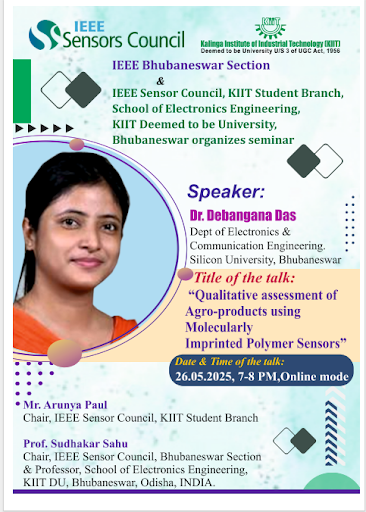
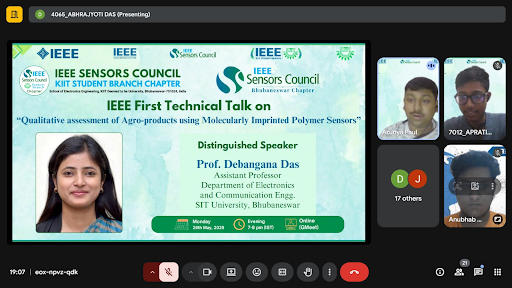
Title of the Invited Talk: Qualitative Assessment of Agro-products using Molecularly Imprinted Polymer Sensors
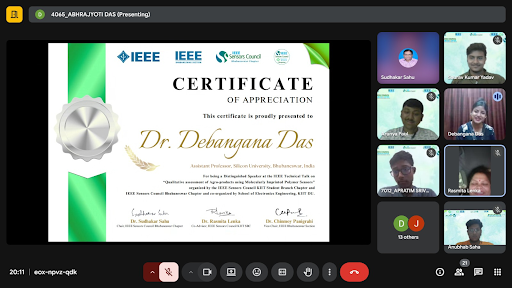
Speaker: Dr. Debangana Das, Assistant Professor, Department of Electronics and Communication Engineering, Silicon University, Bhubaneswar.
Date: Monday, 26th May 2025
Time: 7:00 PM to 8:00 PM
Mode: Google Meet (Online) (https://meet.google.com/eox-npvz-qdk)
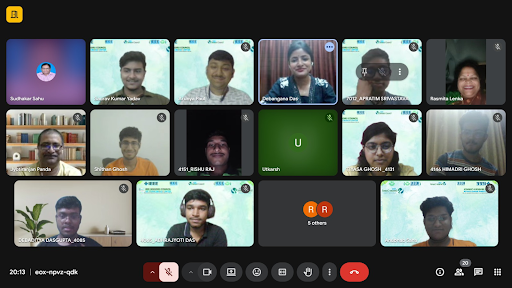
Number of Participants: 20
Purpose of the Event: Academic knowledge enhancement and social awareness and outreach
Write-up on the Event:
The IEEE Online Invited Talk on “Qualitative Assessment of Agro-products using Molecularly Imprinted Polymer Sensors,” organized by the IEEE Sensors Council Student Branch Chapter (SBC) at the School of Electronics Engineering, KIIT (Deemed to be University), Bhubaneswar, on 26th May 2025, was a highly informative and interdisciplinary session aimed at integrating sensor technology with agricultural applications. Conducted from 7:00 PM to 8:00 PM via Google Meet, the session witnessed the active participation of 20 students and researchers, fostering an engaging and interactive learning environment. The talk was delivered by Dr. Debangana Das, Assistant Professor at the Department of Electronics and Communication Engineering, Silicon University, Bhubaneswar, whose expertise in sensor-based systems enriched the discussion. A key highlight of the session was the detailed explanation of Molecularly Imprinted Polymer (MIP) sensors and their application in the qualitative assessment of agro-products for improved food safety and quality monitoring. The speaker elaborated on the working principles, fabrication techniques, and advantages of MIP-based sensing systems in detecting contaminants and ensuring agricultural sustainability. The primary objective of the event was to enhance academic knowledge while promoting social awareness and outreach in the domain of smart agriculture and sensor technologies. Participants gained valuable insights into real-world applications and emerging research opportunities. Overall, the session successfully inspired students to explore innovative solutions at the intersection of electronics, agriculture, and environmental sustainability.