
Jointly organized by IEEE Antennas and Propagation Society (AP-S) and IEEE Microwave Theory and Technology Society (MTT-S) Student branch chapter (SBC), School of Electronics Engineering, KIIT (DU), Bhubaneswar, India and IEEE AP-S & MTT-S Bhubaneswar Joint Chapter (IEEE Bhubaneswar Section)
Event Details:
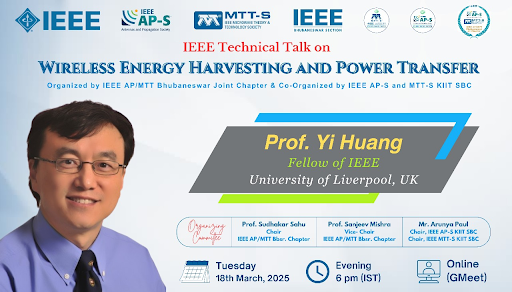
- Title IEEE Invited Technical Talk: Wireless Energy Harvesting and Power Transfer
- Resource Person: Prof. Yi Huang, Professor of Wireless Engineering, University of Liverpool; Fellow IEEE; Author of 500+ papers; Editor, IEEE Transactions on Antennas and Propagation.
- Date: 18 th March 2025 (Tuesday)
- Time: 6:00 PM to 7:30 PM
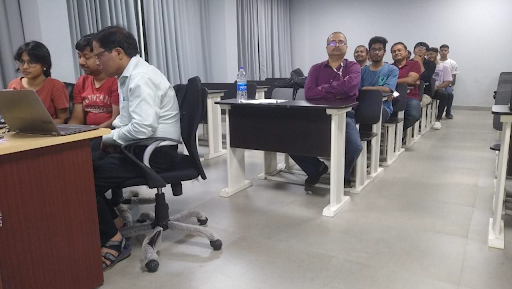
- Venue (Physical Location): Classroom-A, New Building, School of Electronics Engineeing. KIIT (DU)
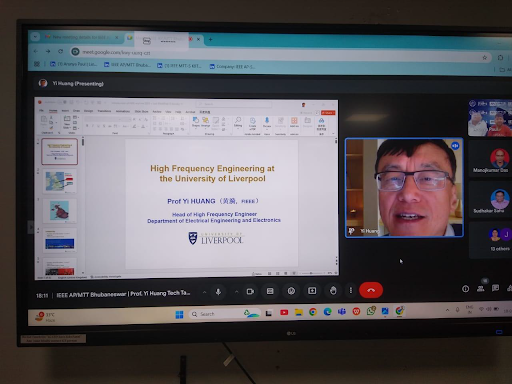
- Mode: Hybrid Online, Google Meet (https://meet.google.com/kwy-uurq-czt)
- Number of Participants: 30
- Purpose of the Event: Academic knowledge enhancement and social awareness and outreach
Write-up on the Event:
The School of Electronics Engineering, in association with the IEEE Antenna and Propagation Society (AP-S), IEEE Microwave Theory and Technology Society (MTT-S) Student Branch Chapter, and the IEEE AP-S and MTT-S Bhubaneswar Joint Chapter, successfully organized an expert talk titled “Wireless Energy Harvesting and Power Transfer” on 18 th March 2025. The session was delivered by Prof. Yi Huang, Fellow of IEEE, Professor of Wireless Engineering at the University of Liverpool, author of over 500 research publications, and Editor of the IEEE Transactions on Antennas and Propagation. The talk focused on recent advancements in rectenna systems for Wireless Energy Harvesting (WEH) and Wireless Power Transfer (WPT). Prof. Huang discussed key challenges and innovations aimed at improving energy conversion efficiency, miniaturization, and system reliability. Special emphasis was placed on RF and microwave-based energy harvesting techniques and their integration with modern communication technologies. Applications in Internet of Things (IoT) devices, electric vehicles, and smart infrastructures were highlighted, demonstrating the potential of WPT to enable sustainable and battery-free systems. Beyond technical discussions, Prof. Huang emphasized the importance of social awareness and outreach, highlighting how wireless energy solutions can contribute to environmental sustainability and improved quality of life. The interactive session inspired students and researchers to explore impactful research directions in energy-efficient wireless systems and emerging power transfer technologies.